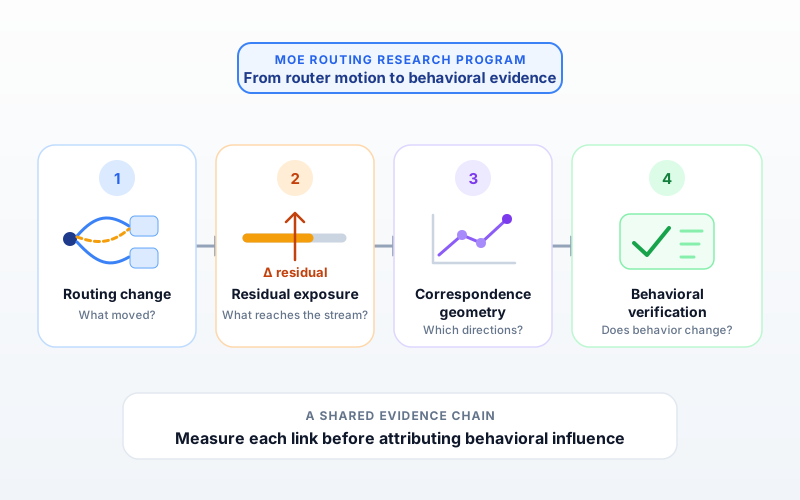
TL;DR. A router can change without telling us how much of that change reaches the model's residual stream, which expert-output directions receive the moved mass, or whether the final behavior changes at all. This program builds that missing measurement ladder. The aim is not to find one more routing score; it is to separate the questions that routing diagnostics often collapse.
Use router divergence to locate change, residual exposure to quantify propagation, correspondence geometry to diagnose where moved mass lands, and behavioral intervention to establish consequence.
Both studies compare two forward passes of the same MoE with the same frozen weights: a demonstration-conditioned teacher and a query-only student. They share the experimental backbone, but their primary estimands are deliberately distinct.
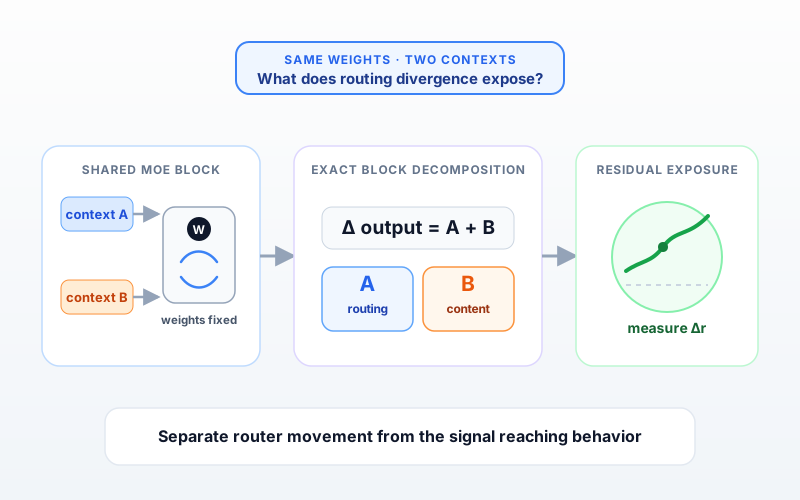
An exact routing/content decomposition tracks a same-weight routing mismatch from the routed block into the residual stream, then tests its effect with causal patches.
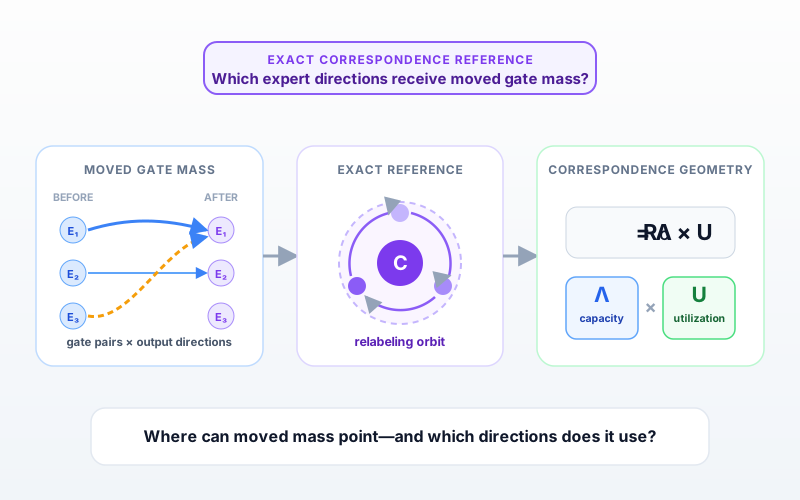
An exact conditional reference asks whether observed gate movement aligns unusually with captured expert-output directions, then tests whether that geometry allocates behavioral measurement.
Separate gate-induced routing mismatch from the dense-like content shift created by changed conditioning.
Measure the routing term relative to the routed block and to the residual stream instead of treating gate movement as influence.
Use geometry as a diagnostic and a behavioral intervention as the evidence when the downstream decision matters.
The residual-exposure study isolates the gate-change component and follows it through the block, backbone, and output.
The correspondence study conditions on captured expert outputs and intact gate pairs to ask where moved mass lands.
An ongoing challenge formulation asks which layers and routing changes are worth measuring when interventions have unequal cost.
Future main-conference work will connect these pieces into a broader account. Details will be added when that study is ready to be public.
The current results concern same-weight, conditioning-induced routing changes. They do not yet establish what happens across accumulated optimization, separately parameterized teachers, reinforcement-learning trajectories, or deployment-scale task outcomes. The studies also show why a single scalar proxy is unlikely to be enough: exposure does not order every behavioral effect, and correspondence geometry reverses as an allocator across checkpoints.